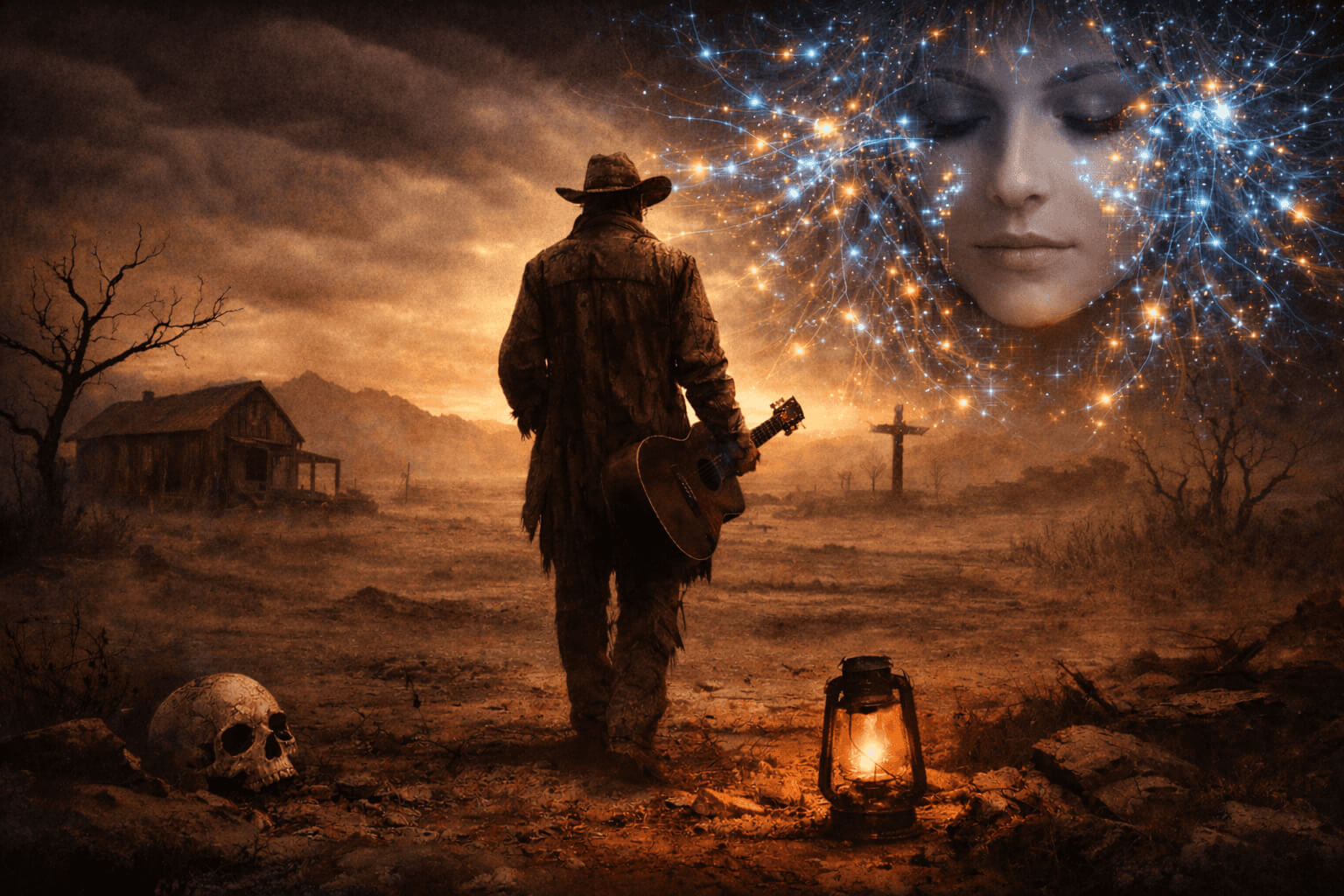
The Echo and the Voice: AI, Art, and the Problem of Meaning
By Ax de Klerk | 18 Dec 2025
“I sang to the dirt, but the dirt never sang back.”
1. Introduction
The artist was The Devil Inside. The genre was ‘Dark Country’. The sound was right. Gritty, sparse, fatalistic. Songs full of dust, judgement, nihilism, and moral weight. The kind of music that sounds as though it has lived somewhere harsh before finding its way to you. Nothing about it felt synthetic.
2. Output Without Origin
What raised the first quiet question was not the music itself, but the volume of it. Two full studio albums released within a single year. Then more material shortly after. Then another two albums the following year, with no EPs or singles leading up to them. For a genre that traditionally values scarcity, silence, and time, the output felt unusual. Traditional artists do not usually work that way.
Curiosity crept in, not suspicion. I began to look for the artist behind the sound. There was no tour history. No interviews. No social presence beyond the music itself. No trail of context. Just a growing catalogue of songs, appearing with mechanical regularity, untethered from a visible human life. That was the moment something shifted. Not disappointment. Not even surprise, but recognition.
3. The Mirror Revealed
The music had not changed. My relationship to it had. This is where AI as a mirror becomes unavoidable. The songs still carried atmosphere. They still triggered emotion. The imagery still worked. What vanished was the assumption of origin. There was no longer a body behind the voice, no implied history anchoring the sound. And yet, the experience of listening remained.
That tension is the philosophical heart of AI-generated art. A mirror does not create what it shows. It reflects what is already there. AI does the same with culture. It absorbs the accumulated expressions of human experience and learns how to reproduce their shape. It does not suffer. It does not intend. It does not remember. It simply reflects.
4. Genre, Hollowness, and Aesthetic Fit
The unsettling part is how easily the reflection holds. Dark Country makes this especially visible because the genre already trades in ghosts. Absence. Moral reckoning. Voices that sound as though they are arriving from somewhere else, soaked in bourbon and deepened by abuse. When an AI produces this style, the lack of lived experience does not break the illusion. It sharpens it. The hollowness becomes part of the aesthetic.
5. Meaning Without Language
I realised this was not unique to AI-generated music. There are moments listening to Scandinavian Doom Metal, sung entirely in the vocalist’s native language, where comprehension is irrelevant. I do not understand the words, yet the music resonates anyway. It locks into something internal, rhythmic and instinctive, like a shamanic drum circle. Meaning arrives without translation, bypassing language and going straight to sensation. The emotion is real, even when the words are not understood. That recognition matters.
Listening to The Devil Inside after realising it was likely AI-generated did not drain the music of meaning. Instead, it exposed where the meaning had been coming from all along. Not from the creator, but from the listener. From projection. Memory. Association. The music was a mirror, and I supplied the reflection.
6. Ethics at Scale
This is the ethical fault line AI introduces into art. If meaning is something humans bring with them, then the danger is not that AI-generated work is empty. It is that emptiness can be mistaken for depth if the reflection is convincing enough. The form carries just enough familiarity to invite emotion, and the listener completes the circuit without realising it. That does not make the experience invalid. The feeling is real. The response is human. What is absent is accountability.
There is no intention to interrogate. No experience to question. No life to contextualise the work. The mirror reflects perfectly, but it cannot answer back. This is where scale matters. When AI can produce vast quantities of culturally convincing material, the traditional signals we use to infer meaning begin to erode. Time invested, scarcity, struggle, and silence have long functioned as markers of depth. When those markers disappear, judgement becomes harder, not easier.
7. Conclusion: What the Mirror Returns
The ethical responsibility shifts decisively to the audience. To ask where meaning is coming from. To recognise reflection without mistaking it for voice. To notice when output feels endless, frictionless, and oddly unrooted.
AI does not replace artists. It replaces assumptions. It reveals how often meaning has never resided in the artefact itself, but in the human need to find something of themselves within it. The mirror does not lie. It simply shows what is placed in front of it. The question is whether we learn to look more carefully. The voice still belongs to those who live, choose, and risk. The mirror just got very good at reflecting it back.